Hearing changes tend to surface in small, specific moments, like asking your daughter to repeat herself at Sunday dinner or noticing that the television volume has crept up again. If you have started researching, the long list of hearing aid features can feel like a wall of technical language that raises more questions than it answers.
At Padgett Hearing Aid Center, we want to clear that up. Some features are worth prioritizing for almost everyone, while others depend entirely on how you spend your days. This guide covers the features that genuinely change daily life, what independent research says about them, and the questions worth bringing to your first conversation with a specialist, so you can get back to catching every word at the dinner table.
What This Guide Covers
- The hearing aid features that do the most work for understanding speech, especially in noise.
- What higher technology levels add, and what an NIH-funded trial found about their real-world value.
- How telecoils, rechargeable batteries, Bluetooth, and apps fit different daily routines.
- How style affects which features fit in the device.
- Questions to ask before you choose, and how consumer earbuds compare with hearing aids.
Which Hearing Aid Features Matter Most?
Every hearing aid has a microphone, an amplifier, and a speaker, according to the National Institute on Deafness and Other Communication Disorders (NIDCD). Digital models convert sound into numerical codes before amplifying it, so a hearing care professional can amplify some pitches more than others and can program the device to focus on sound coming from a specific direction. That programmability is the reason the features below matter.
It also helps to know why feature choices carry weight. NIDCD reports that only about one out of five people who would benefit from a hearing aid actually uses one. Part of that gap comes from devices that were poorly matched to the person wearing them, which is why it pays to choose features based on your life rather than a spec sheet.
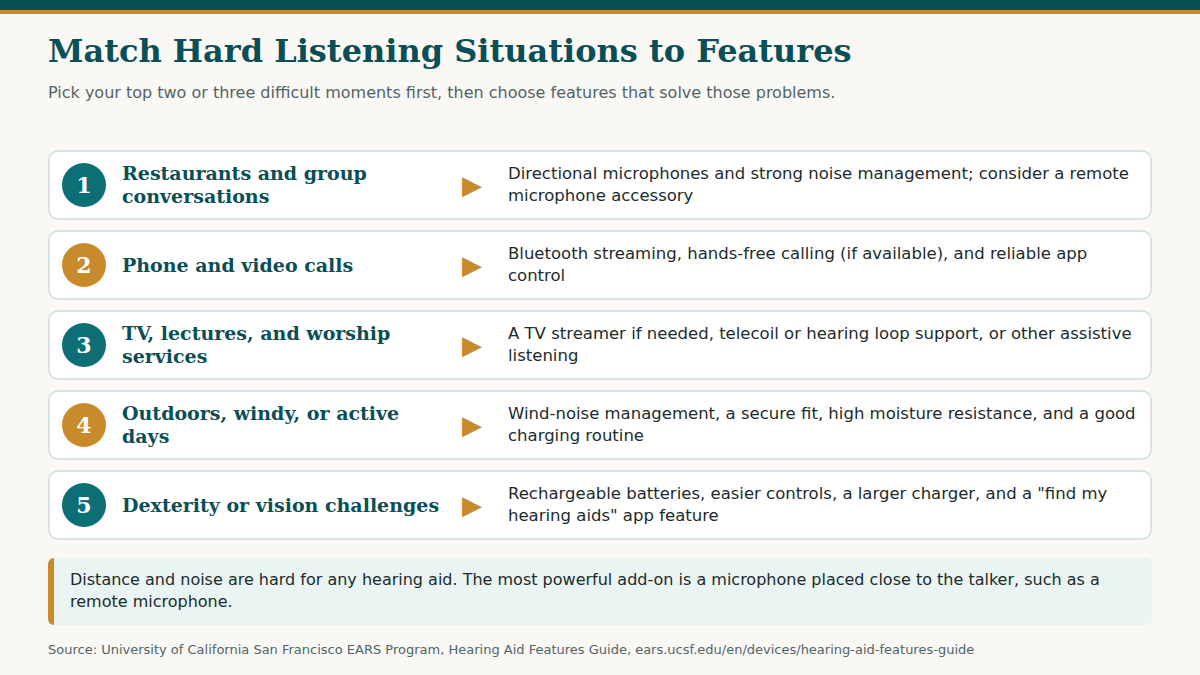
A useful way to sort the options is into three groups: features that help you understand speech, features that connect you to phones, televisions, and public venues, and features that keep the devices comfortable enough to wear every day. The graphic below matches common hard situations to the features that address them.
Essential Hearing Aid Features for Noisy Places
Background noise is the most common complaint, so the tools that manage it deserve the most attention. Most hearing aids use two microphones per ear and combine them to emphasize sound from in front of you. According to the University of California San Francisco guide, this can improve comfort and often helps speech understanding in many real-world noisy settings, especially when you are facing the person you want to hear. NIDCD adds that directional microphones are a promising way to make it easier to hear a single conversation when other voices and noises surround you.
Noise reduction works differently. It softens sounds that behave like noise, such as steady hums, while preserving speech. For many people the biggest benefit is less annoyance and less listening effort rather than a magical mute button for a busy restaurant. Wide dynamic range compression adds another layer by boosting softer sounds more than louder ones, so speech becomes audible while loud sounds stay comfortable.
| Feature | What it does | Helps most with |
|---|---|---|
| Directional microphones | Emphasize sound arriving from in front of you | Conversation in restaurants and groups when you face the talker |
| Noise reduction | Softens steady, noise-like sounds and preserves speech | Lowering annoyance and listening effort in busy places |
| Compression | Boosts soft sounds more than loud sounds | Keeping speech audible without making loud sounds uncomfortable |
| Feedback control | Reduces whistling from sound leaking back into the microphone | Phone calls and close conversation |
| Remote microphone | Places a microphone close to the talker | Distance and very noisy rooms |
Feedback Control and Own-Voice Comfort
Modern hearing aids use adaptive feedback control to reduce whistling without giving up as much high-pitched amplification. If whistling is frequent, it often points to a fit issue, earwax, or the need for an adjustment. NIDCD notes that a hearing aid that does not fit or work well, or is clogged by earwax or fluid, can whistle.
Many new wearers also notice that their own voice sounds boomy or too loud. NIDCD calls this the occlusion effect and describes it as very common; most people get used to it over time, and an audiologist can often correct it with fit or programming changes.
Do Higher Hearing Aid Technology Levels Matter?
Hearing aids are typically offered in technology levels, from basic to premium. According to the University of California San Francisco guide, the differences usually involve how aggressively and intelligently the device handles noisy environments and how automatic it is. In quiet situations, performance across levels can feel more similar, with the gaps showing up most in noise and complexity.
So how much does the extra level of technology matter in daily life? An NIH-funded, participant-blinded crossover trial put the question to the test. Forty-five older adults with mild-to-moderate sensorineural hearing loss wore four pairs of hearing aids for one month each: premium and basic models from two major brands. Hearing aids helped in both cases. Yet the only statistically significant advantage for premium devices was less listening effort in a loud laboratory condition, for one of the two brands, and the effect was small. The researchers concluded that, when fitted using scientifically based practices, premium-feature and basic-feature hearing aids provided essentially equivalent improvements to speech understanding and listening effort in daily life for this group.
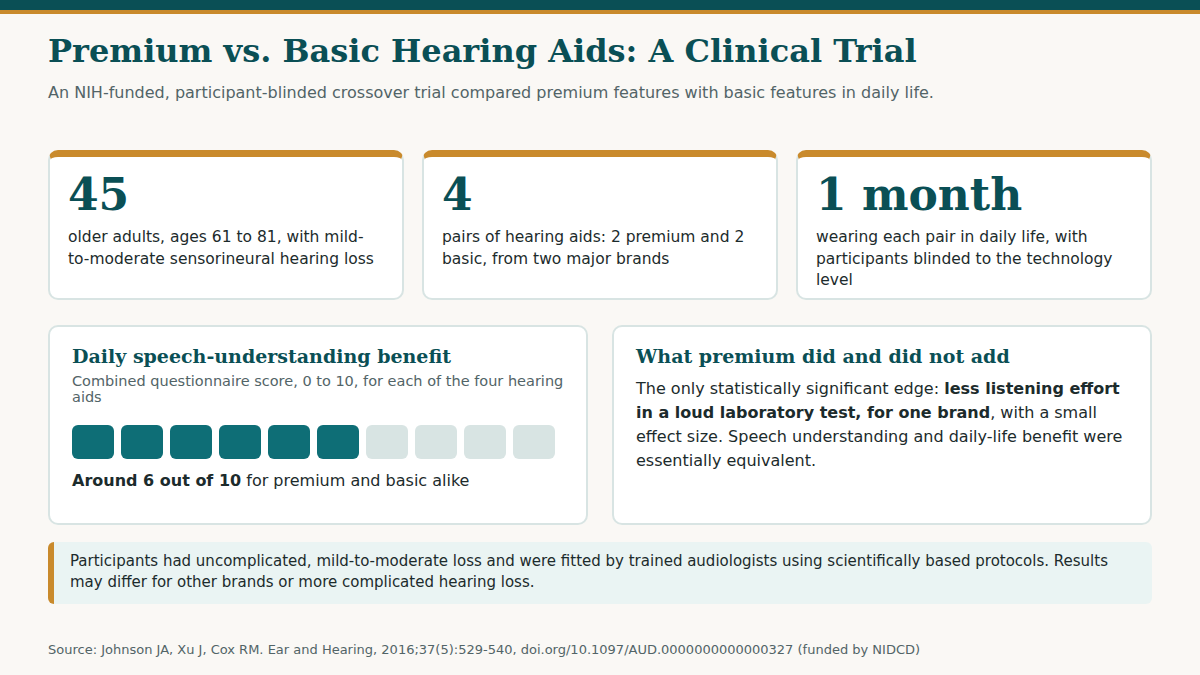
The hearing aids in that trial did differ on paper, as the table below shows. These were 2011 models, and products have changed since, but the comparison illustrates what a higher level typically buys.
| Feature | Premium | Basic |
|---|---|---|
| Compression channels | 16 (A) and 20 (B) | 8 (A) and 6 (B) |
| Directional microphone | Automatic multi-channel adaptive | Automatic single-channel adaptive |
| Noise reduction | 7 steps (A) and 3 modes (B) | 3 steps (A) and 2 modes (B) |
| Automatic adaptation to the environment | More | Less |
None of this means advanced features are never worth it. The trial involved typical older adults with uncomplicated loss, and the authors noted that other brands or more complicated hearing loss could produce different results. NIDCD offers the practical takeaway: do not use price alone to choose a hearing aid, because a more expensive model does not necessarily suit your needs better. The University of California San Francisco guide agrees that a well-fit mid-level device can outperform a premium device that is poorly fit or poorly matched to your needs.
That is why fit quality matters as much as the feature list. Careful professional hearing aid fitting, including verification that the device delivers the right sound in your own ear, is what turns a feature list into real-world clarity. It all begins with a comprehensive hearing test, which shows which pitches need support and how well you understand speech.
Hearing Aid Styles and the Features They Can Hold
Style and features are connected, because smaller devices leave less room for batteries and extras. NIDCD describes three basic styles. Behind-the-ear aids are used for mild to profound hearing loss. In-the-ear aids fit completely inside the outer ear and are used for mild to severe hearing loss, and some include a telecoil. Canal aids, which include in-the-canal and completely-in-canal designs, are used for mild to moderately severe hearing loss; they are small, can be harder to adjust and remove, and have less space for batteries and a telecoil.
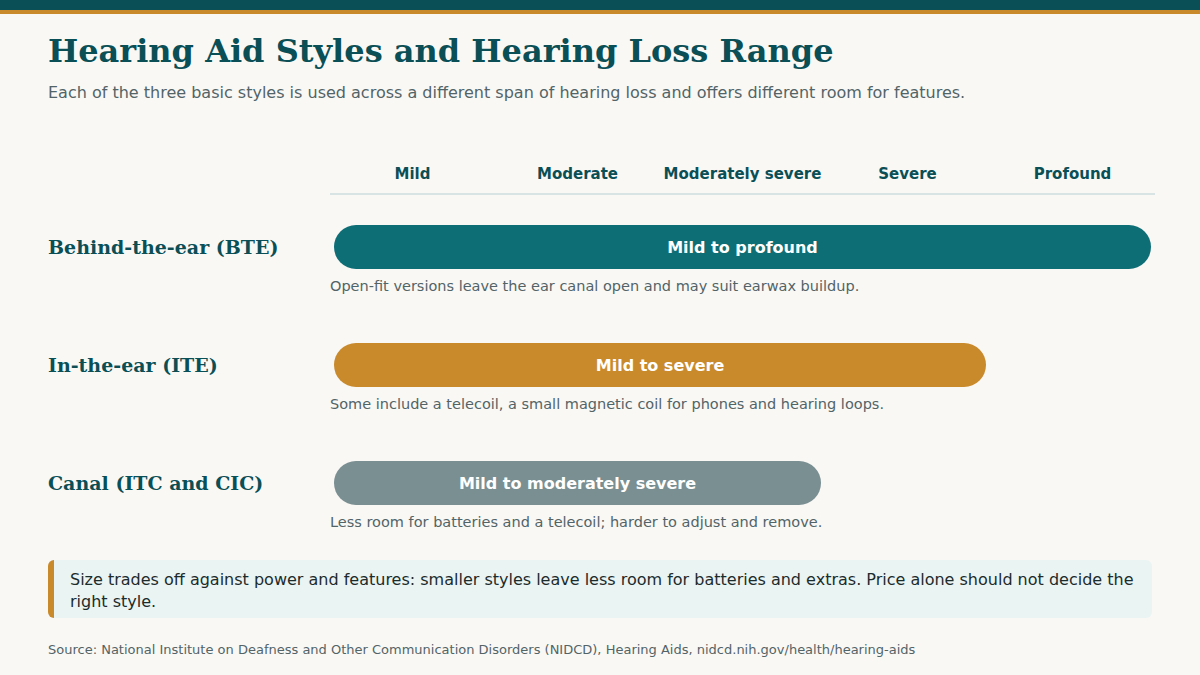
Open-fit behind-the-ear devices leave the ear canal open, which may suit people with earwax buildup and can reduce the plugged-up sound of your own voice. If a particular feature matters to you, such as a telecoil or a rechargeable system, the style you choose may decide whether it is available. You can explore modern hearing aid styles and technology before your appointment, then try a few in person.
Telecoils and Hearing Loops: A Small Feature With a Big Effect
A telecoil lets you receive sound through the hearing aid circuitry rather than its microphone, according to NIDCD. That makes phone conversations easier and gives you direct access to induction loop systems, which are installed in many churches, schools, airports, and auditoriums. In a looped room, the audio reaches your hearing aids without the clatter of the room getting in the way.
Telecoils are a hardware feature. The University of California San Francisco guide explains that if you want one, you generally need to choose a style or model that includes it, and it is not something you can add later. Auracast, a newer Bluetooth broadcast technology designed to send venue audio to compatible devices, is promising, but venue rollout is still emerging, and loops remain more common in many places. If you attend services, theater, or community events regularly, ask about telecoil support specifically.
Comfort and Convenience Features
The best feature list in the world does nothing if the devices stay in a drawer. Comfort and convenience features are what make daily wear realistic.
Rechargeable Batteries
Tiny disposable batteries require fine motor control, which can become genuinely hard with arthritis or reduced dexterity or vision. Rechargeable hearing aids avoid that problem: you place them in a charging case overnight and they are ready the next morning. The University of California San Francisco guide notes that most users get a full day on one charge, although heavy streaming can shorten run time, and that disposable batteries still make sense for some very small styles. Because small canal styles have less battery room, rechargeable options tend to be easier to find in larger styles. You can compare rechargeable hearing aids to see which styles offer them.
If you do use disposable button batteries, store them out of reach of children and pets. They can be extremely dangerous if swallowed, and poison control should be contacted right away if ingestion is suspected.
Bluetooth Streaming and Apps
Bluetooth can stream phone calls, video calls, podcasts, navigation prompts, and, with the right setup, television audio straight into both hearing aids. Because the sound arrives directly at your ears instead of competing with the room, it can be a major clarity upgrade. A few practical points apply:
- Compatibility matters: confirm that your exact phone model supports the features you want, including streaming, hands-free calling, and app control.
- Hands-free calling varies: some models use the hearing aid microphones for your voice, while others still use the phone microphone.
- Streaming uses power: more streaming means more battery use, especially during long meetings.
- Apps add control: most include volume and program changes, and many include a find-my-hearing-aids tool and basic troubleshooting.
Durability, Moisture, and Care
Hearing aids face sweat, humidity, earwax, and the occasional drop. Many are rated with an Ingress Protection (IP) code that describes dust and water resistance, but the University of California San Francisco guide cautions that water resistant does not necessarily mean swim-proof. NIDCD recommends keeping hearing aids away from heat and moisture, cleaning them as instructed, and avoiding hairspray while wearing them. Routine professional hearing aid cleaning keeps microphone openings clear, and our hearing aid repair service helps when a device sounds muffled, cuts out, or stops working.
How Lifestyle Should Guide Your Choice
Matching a hearing aid to your life starts with an honest look at how you actually spend your time, not the most demanding scenario you can imagine. The University of California San Francisco guide suggests picking your top two or three hard situations and matching features to them. A few common profiles show how that works:
- Quiet routines at home: solid compression, feedback control, and basic noise management often cover the main challenges, and a simple Bluetooth connection for the television or phone can add a lot.
- Busy social calendars: directional microphones, strong noise management, telecoil support for worship services and events, and possibly a remote microphone become more valuable.
- Active outdoor lives: wind-noise management, a secure fit, high moisture resistance, and a dependable charging routine matter most.
- Dexterity or vision challenges: rechargeable batteries, easier controls, and a larger charger take priority.
There is no shame in starting with a simpler feature set and adjusting as you learn how you actually use the devices. The goal is minimum frustration, not maximum features.
Questions to Ask Before You Choose
Walking into a fitting consultation with a prepared list changes the feel of the appointment. You become an active participant, and the specialist gets the information needed to make useful recommendations. Our hearing care services are built around these conversations, and these questions are a good place to start:
- Which features in this device directly support my most common daily activities?
- How do the automatic settings handle moving between quiet and noisy spaces, and can I hear an example?
- Does this model include a telecoil for loop systems at my church or community center?
- What are the rechargeable options, and how does battery life hold up during streaming?
- Is this feature compatible with my exact phone model?
- Is there a trial period? NIDCD notes most manufacturers allow a 30 to 60 day trial period, so ask what fees are nonrefundable.
- What follow-up, cleaning, and programming adjustments are included after the first fitting?
Can Consumer Earbuds Replace Hearing Aids?
Many people arrive wondering whether wireless earbuds or a smartphone could fill the gap. The answer is more nuanced than it used to be. In 2022 the FDA created an over-the-counter category for adults 18 and older with perceived mild to moderate hearing loss, who can buy hearing aids without a medical exam, a prescription, or a visit to an audiologist. In September 2024, the FDA authorized the first over-the-counter hearing aid software for compatible Apple AirPods Pro. It uses a self-fitting approach, and in a clinical study of 118 people, those who self-fit achieved similar perceived benefit to those who received professional fitting of the same device.
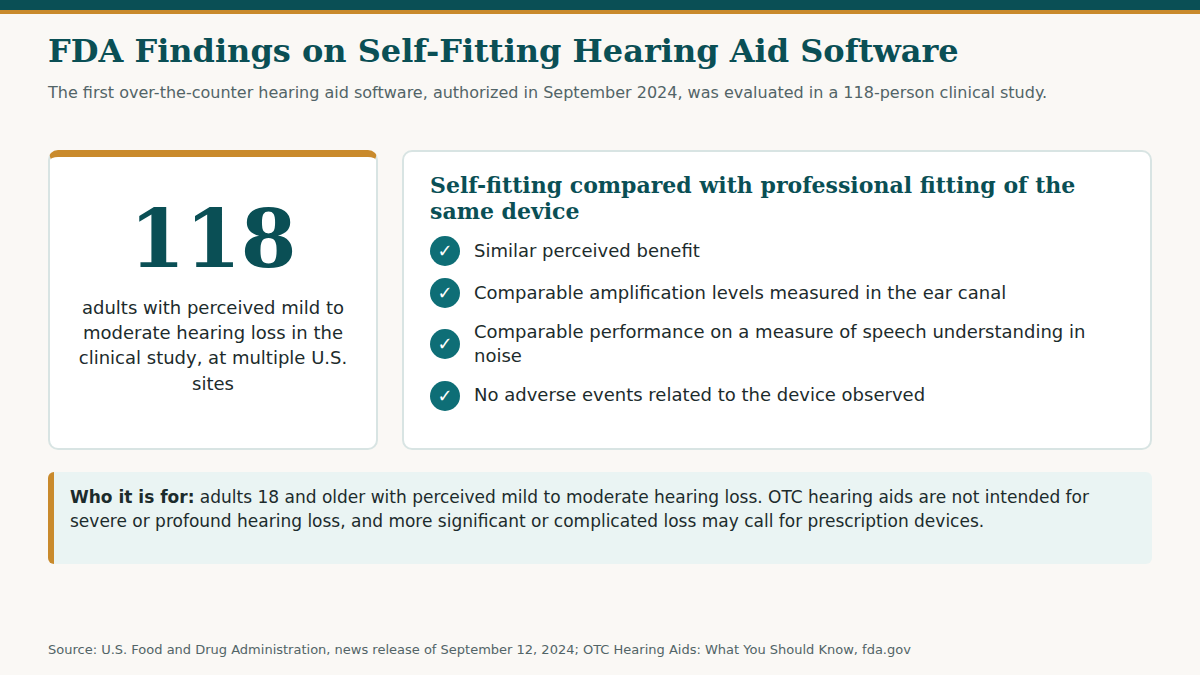
The boundaries still matter. The FDA's guidance is clear that over-the-counter devices are intended only for perceived mild to moderate hearing loss, not severe or profound hearing loss. NIDCD adds that prescription hearing aids or other devices may be necessary for more significant or complicated hearing loss.
| Consideration | Over-the-counter option | Prescription hearing aids |
|---|---|---|
| Who it is for | Adults 18 and older with perceived mild to moderate hearing loss | All degrees of hearing loss, including more significant or complicated loss |
| How it is fitted | Self-fitting without a hearing professional | Programmed by a hearing health professional for your degree of loss |
| Hardware choices such as a telecoil | Vary by product, so check before you buy | Chosen with you by style and model during selection |
If you are not sure how significant your hearing loss is, a professional evaluation is the clearest way to find out. You can also learn more about hearing loss causes and treatment options before deciding which route fits you.
Frequently Asked Questions About Hearing Aid Features
Can I use AirPods Pro as hearing aids?
The FDA authorized a software feature for compatible Apple AirPods Pro that lets them serve as an over-the-counter hearing aid for adults 18 and older with perceived mild to moderate hearing loss. It uses a self-fitting approach, and in a 118-person clinical study, people who self-fit reported similar benefit to those who received professional fitting of the same device. It is not intended for severe or profound hearing loss. If your loss is more significant or complicated, or you want features such as a telecoil, ask about prescription hearing aids.
How do hearing aid apps work?
Most hearing aids include a smartphone app for changing volume and programs, and some add deeper adjustments, a find-my-hearing-aids tool, and basic troubleshooting. Some clinics can also fine-tune settings remotely through the app. Compatibility varies, so confirm that your exact phone model supports the features you care about, such as streaming, hands-free calling, and app control.
What is a telecoil, and why does it matter?
A telecoil is a small magnetic coil built into some behind-the-ear and in-the-ear hearing aids. It lets you receive sound through the hearing aid circuitry instead of the microphone, which makes telephone conversations easier and helps in places with induction loop systems, such as many churches, schools, airports, and auditoriums. Because a telecoil is hardware, you generally need to choose a style that includes it from the start.
Do directional microphones and feedback control work together?
Yes, but they solve different problems. Directional microphones emphasize sound coming from in front of you, usually the person you are talking with. Feedback control reduces the whistling that can occur when amplified sound leaks back into the microphone. Frequent whistling often points to a fit issue, earwax, or a needed adjustment rather than a feature problem.
Do more expensive hearing aids work better?
Not necessarily. NIDCD notes that a higher price does not automatically mean a hearing aid will better suit your needs. In a participant-blinded NIH-funded trial of 45 older adults with mild-to-moderate hearing loss, premium-feature and basic-feature hearing aids provided essentially equivalent daily-life benefit when professionally fitted. Results may differ for other brands or more complicated hearing loss, so the right level depends on your listening situations.
Are rechargeable hearing aids always better?
Rechargeable hearing aids are usually more convenient and are especially helpful for people with dexterity or vision challenges, and most people get a full day from one charge. Heavy streaming can shorten run time, and disposable batteries can still make sense for some very small styles or long stretches away from a charger.
How do I choose hearing aid features for my lifestyle?
Start with your top two or three hardest listening situations, such as restaurants, phone calls, or worship services, and match features to those problems. A quiet routine may need fewer advanced features than a schedule full of group conversations. A professional hearing evaluation and a conversation about your typical week make the choice much more focused.
What is the best add-on for noisy places or distance?
A remote microphone. It places a microphone close to the talker, which is something the microphones in your hearing aids cannot do from across a room. It often delivers the biggest improvement in distance and in very noisy settings.
Visit a Hearing Care Office Near You
Come experience these features in person. Each office can walk you through what each technology sounds like in a real listening environment.
| Office | Address | Phone |
|---|---|---|
| Brenham | 103 W Alamo St | (979) 830-0865 |
| Bastrop | 1670 State Hwy 71, Suite C | (512) 522-8849 |
| Katy | 1926 Avenue D | (281) 407-6090 |
| Texarkana | 5124 Summerhill Rd | (903) 794-5839 |
All four offices are open Monday to Thursday from 8:30 AM to 5:00 PM and Friday from 8:30 AM to 2:00 PM.
Find the Features That Fit the Life You Live
Staying connected to the people and moments that matter, like catching a grandchild's joke, following the sermon without straining, or hearing your name called across a crowded room, is what this technology is for. Features are tools in service of that goal, not ends in themselves, and no device delivers its full value without professional programming tailored to your hearing and your daily environment.
Since 1979, our team has focused on honest guidance and unhurried appointments. You can meet our hearing care team and read patient success stories to see how we work. You do not have to decide anything before you are ready.
When you are, contact us to schedule your visit and let us help you get back to your favorite sounds.