You can hear the television from the next room and tell when someone is speaking across the dinner table, yet the words themselves arrive as a blur. If that sounds familiar, the real answer to how do hearing aids work has very little to do with volume. It has to do with how a small device restores the pieces of speech your ears have stopped delivering, so you can follow the story at a family dinner and hear a grandchild without straining.
At Padgett Hearing Aid Center, we hear about this gap between hearing and understanding often. Modern hearing aids are not simple amplifiers. They are small digital speech processors that shape sound around the specific pitches you struggle to hear, and the way they are fitted decides how much clarity you actually gain.
This guide explains the technology in plain language, shares what government and clinical research say about it, and walks through what a professional fitting adds.
What This Guide Covers
- How digital hearing aids process speech differently from a simple amplifier.
- Why you can hear people talking yet miss the words, and what that means for your hearing.
- How directional microphones and noise reduction help in restaurants and group conversations.
- Why programming and real-ear verification change real-world results.
- What to expect while your brain adjusts, and how to keep your hearing aids working well.
How Do Hearing Aids Work to Improve Speech Clarity?
Every hearing aid has three basic parts: a microphone, an amplifier, and a speaker. The microphone converts sound waves into electrical signals, the amplifier increases the power of those signals, and the speaker delivers the stronger signal to your ear, according to the National Institute on Deafness and Other Communication Disorders (NIDCD).
Most modern hearing aids add digital circuitry to that basic design. Digital hearing aids convert sound waves into numerical codes before amplifying them. Because the code carries information about each sound's pitch and loudness, the device can amplify some frequencies more than others. Digital circuitry also lets a hearing care professional program the device to focus on sounds coming from a specific direction.
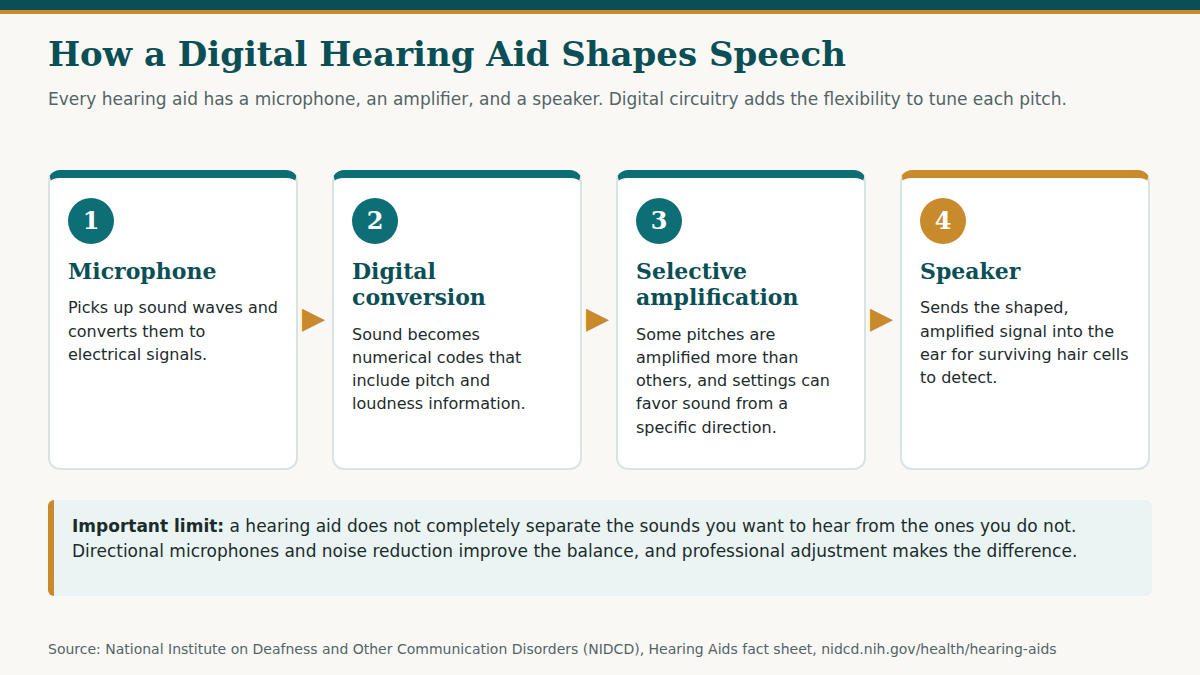
This approach works best for sensorineural hearing loss, which results from damage to the tiny hair cells of the inner ear. Surviving hair cells detect the larger vibrations a hearing aid provides and pass them to the brain as neural signals. Hearing aids come in several styles, from behind-the-ear to in-the-canal designs, and the best choice depends on the kind and severity of your hearing loss. You can compare modern hearing aid styles and technology before your appointment.
How Do Hearing Aids Work Differently From a Simple Amplifier?
A simple amplifier treats every sound the same. Turn it up and the voice across the table gets louder, but so do the silverware, the air conditioner, and everything else competing with it. The voice is louder, yet no clearer.
A digital hearing aid divides sound into channels by pitch and adds volume only where your hearing test shows you need it. Because age-related and noise-related hearing changes commonly affect higher pitches before lower ones, this approach restores soft, high-pitched speech detail without over-amplifying sounds you already hear well.
Think of it as adjusting the equalizer on a stereo rather than raising the master volume. Your hearing care professional uses your audiogram, the chart of the softest sounds you can detect at each pitch, to set each band so the output matches what your ears actually need.
Why You Can Hear Speech but Not Understand the Words
Speech is a mix of low, middle, and high pitches. Vowels are generally louder and lower in pitch, while consonants such as /s/, /p/, and /k/ tend to be higher in pitch. Manitoba Education's guide to hearing offers a simple example: in the word "moose," the /m/ is a low-pitched sound, the /oo/ is a middle-pitched sound, and the /s/ is a high-pitched sound. To catch the whole word, your ears need to detect all three.
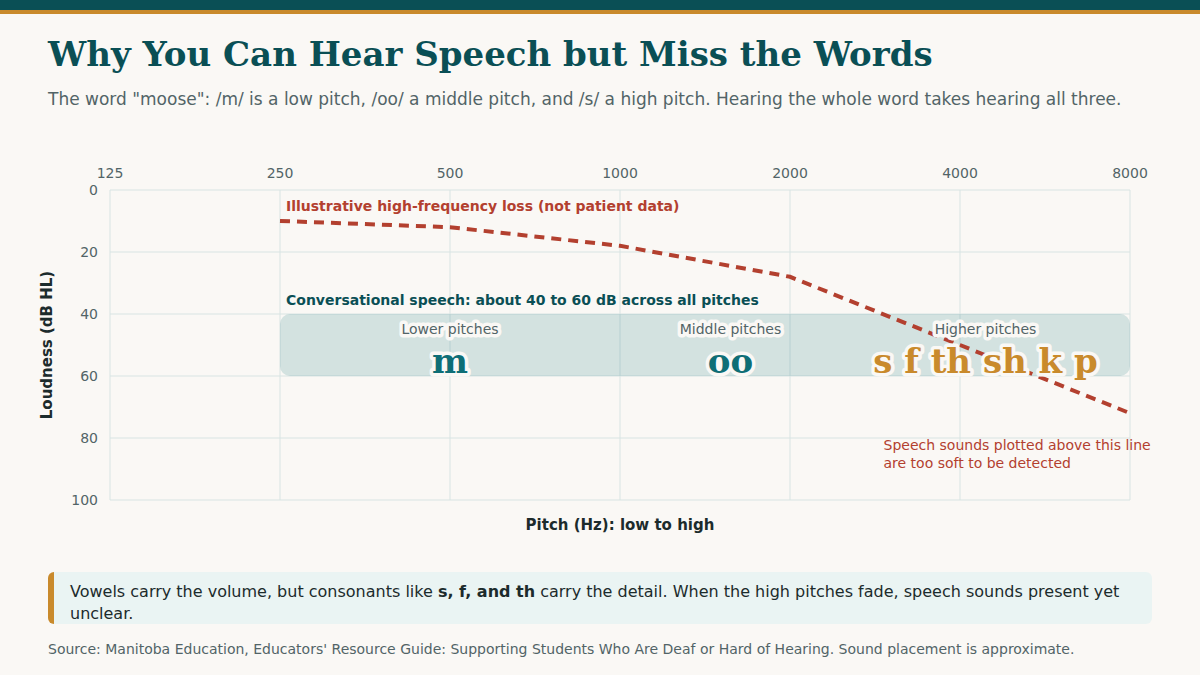
When the high pitches fade, you still notice the volume of speech, but the soft consonants that separate one word from another go missing. Conversation sounds muffled even though voices seem loud enough. Pairs like these are easy to confuse when the high-pitched detail drops out:
| Word pair | The sounds that tell them apart |
|---|---|
| show and throw | /sh/ versus /th/ |
| cat and hat | /k/ versus /h/ |
| fine and mine | /f/ versus /m/ |
Over time, that missing detail can add up in everyday life:
- Muffled speech: without crisp consonants, conversations can sound like an indistinct murmur.
- Extra listening effort: your brain works harder to fill in the gaps, which can leave you tired after a long family dinner.
- Pulling back socially: the constant effort of following conversations can make gatherings less enjoyable.
Hearing changes like these can result from aging, noise exposure, certain medications, and other causes. If you want to understand what may be behind your symptoms, start with the causes of hearing loss and treatment options.
Hearing Aids for Speech Clarity in Noisy Places
Restaurants, family gatherings, and church fellowship halls are difficult because background noise competes directly with the speech you want to hear. Two tools work together to improve that balance: directional microphones and noise reduction.
Directional Microphones: A Spotlight for Sound
Directional hearing aids use more than one microphone to favor sound arriving from a particular direction, usually the direction you are facing. According to NIDCD, directional microphones amplify sound from that direction but not from other directions, which holds promise for making it easier to follow a single conversation when other voices and noises surround you. They work best when the person you want to hear is in front of you and the noise is behind or beside you, as explained in the University of California, San Francisco hearing aid features guide.
Several configurations are common:
- Fixed directional microphones stay focused on the area in front of you, which suits one-on-one conversation.
- Adaptive directional microphones switch automatically between all-around and directional listening based on the noise level in the room.
Noise Reduction: Quieting What Is Not Speech
While directional microphones reduce noise from specific locations, digital noise reduction works differently. It analyzes the acoustic character of incoming sound, tells noise-like sounds apart from speech-like sounds, and lowers amplification for the noise. It can distinguish steady sounds, such as the hum of an air conditioner, from the rhythm of a voice. For a deeper technical look, the National Institutes of Health's PubMed Central hosts a review of microphone technologies and noise reduction algorithms.
| Feature | What it does | Helps most with |
|---|---|---|
| Directional microphones | Focus on sound in front of you | One-on-one conversation in a busy room |
| Adaptive directionality | Switches listening modes automatically | Moving between quiet and noisy settings |
| Digital noise reduction | Lowers amplification for steady, noise-like sounds | Air conditioners, fans, and traffic hum |
| Wind noise reduction | Reduces wind passing over the microphones | Conversations outdoors |
| Impulse noise reduction | Softens sudden sounds | Dishes clattering in a restaurant |
No hearing aid completely separates the sounds you want to hear from the ones you do not. Directional microphones and noise reduction improve the balance, and programming specific settings for the places you spend time, such as a quiet living room, a favorite restaurant, or the car, helps the device perform where it matters most.
Why Professional Programming and Fitting Change the Results
A hearing aid in its box is sophisticated hardware with little value until it is programmed for you. The process starts with a comprehensive hearing test that measures the softest sounds you can detect from low pitches to high pitches, plotted on an audiogram. Speech testing adds a measure of how well you understand spoken words, not just detect tones. The difference between detecting a tone and understanding a word is exactly what separates "I can hear fine" from "I just can't follow what anyone is saying."
Clinical formulas, such as the NAL-NL2 prescriptive target, translate your audiogram into a goal for how much amplification to deliver at each pitch. That target is a starting point, not a finish line. Your hearing care professional then refines it using your feedback from real listening situations and follow-up visits.
Real-Ear Measures: Verifying the Fit
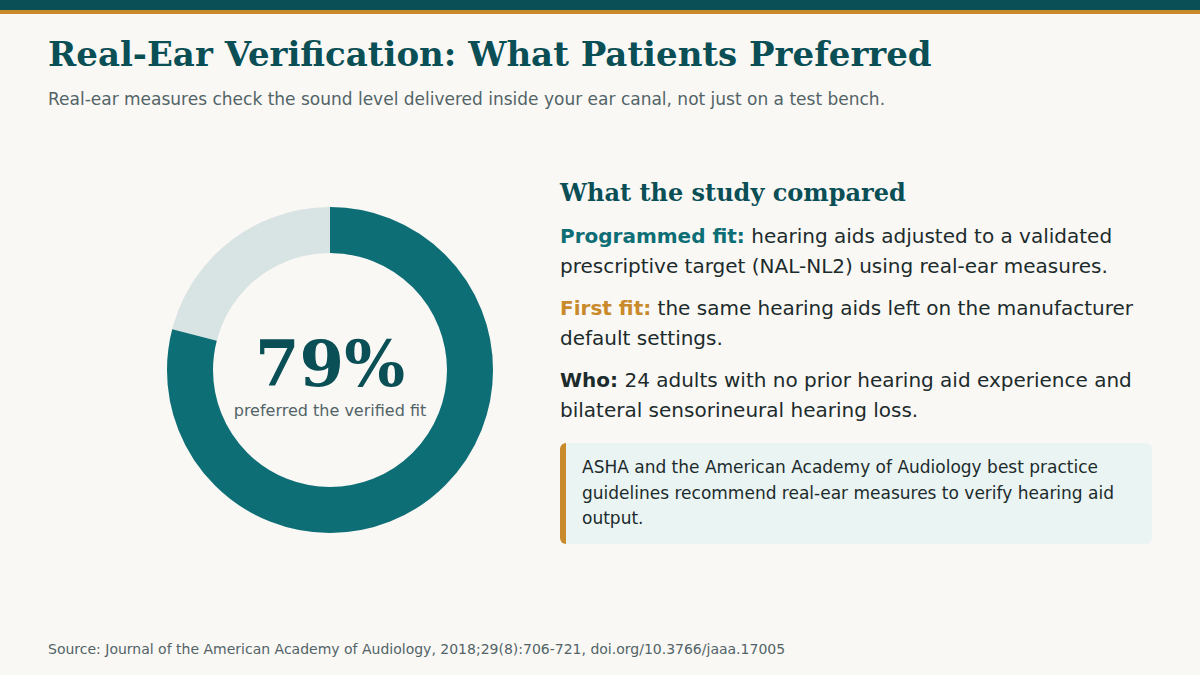
Real-ear measures use a thin probe microphone placed in the ear canal to check the sound the hearing aid actually delivers near your eardrum while it is running. Because ear canals differ in size and shape, output measured in your ear can differ from what fitting software predicts. The American Speech-Language-Hearing Association and the American Academy of Audiology both recommend real-ear measures to confirm that hearing aid output matches a validated prescriptive target.
The evidence supports the practice. In a study of 24 adults with no prior hearing aid experience, 79 percent preferred hearing aids programmed with real-ear measures over the same devices left on manufacturer first-fit settings.
Careful professional hearing aid fitting goes beyond the first programming session. It also covers physical comfort and the common adjustment issues new wearers notice:
- Tailored amplification: settings built from your hearing test so the device addresses your pattern of hearing changes, not a generic profile.
- A comfortable physical fit: the right dome, tubing, or earmold helps prevent whistling feedback.
- Relief from the "plugged-up" feeling: the occlusion effect, where your own voice sounds too loud, is very common for new users and can often be corrected.
- Listening programs for your routine: separate settings for quiet rooms, restaurants, television, and phone calls.
What About Over-the-Counter Hearing Aids?
The FDA created the over-the-counter category for adults 18 and older with perceived mild to moderate hearing loss, who can buy these devices without seeing an ear-nose-throat doctor or audiologist. The FDA's guidance is clear that these devices are not intended for severe or profound hearing loss. NIDCD adds that prescription hearing aids or other devices may be necessary for more significant or complicated hearing loss.
If you can hear speech but struggle to understand it, a hearing test is the simplest way to learn which type of device fits your hearing and how much support you need.
Who Benefits From Hearing Aids for Speech Clarity?
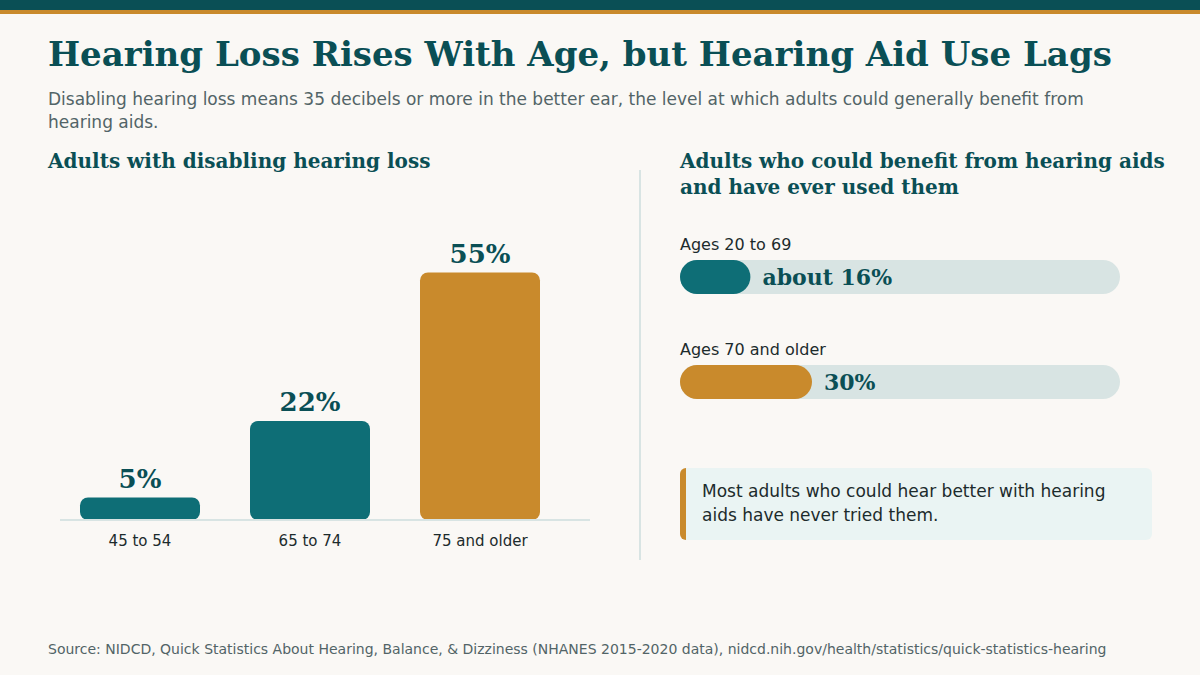
Hearing loss becomes more common with age. According to NIDCD, about 5 percent of adults ages 45 to 54 have disabling hearing loss, compared with 22 percent of those ages 65 to 74 and 55 percent of those 75 and older. Yet among adults ages 70 and older who could benefit from hearing aids, only about 30 percent have ever used them, and the share is even lower, approximately 16 percent, for adults ages 20 to 69.
You may be a good candidate for an evaluation if you notice any of these patterns:
- You hear people talking but frequently miss words, especially in restaurants or group settings.
- You ask people to repeat themselves or to speak more clearly.
- You turn the television louder than others prefer.
- Phone calls take more concentration than they used to.
- You feel unusually tired after social events because listening takes so much effort.
Our hearing care services cover evaluation, hearing aid selection, fitting, maintenance, and follow-up, so you have one team from your first appointment through the adjustment period and beyond.
Realistic Expectations for Better Conversation Understanding
A hearing aid will not restore normal hearing. NIDCD notes that with practice, however, a hearing aid increases your awareness of sounds and where they come from. Hearing aids take time and patience to use successfully, and wearing them regularly helps you adjust.
Your brain needs time to relearn sounds that have been faint for years. Running water, paper rustling, footsteps, and dishes may seem more noticeable at first. That does not necessarily mean the settings are too loud. It often means the brain is rediscovering sounds it stopped hearing. A few habits make the transition smoother:
- Wear your hearing aids consistently, then add more challenging settings such as restaurants and group conversations.
- Keep your follow-up visits so settings can be refined as you notice what works and what does not.
- Report specific problems, such as feedback, a voice that sounds too loud, or noise that remains distracting, so they can be addressed.
- Ask about the trial period. NIDCD notes most manufacturers allow a 30 to 60 day trial for returns.
If you have hearing loss in both ears, NIDCD generally recommends two hearing aids, because they provide a more natural signal to the brain and help you understand speech and locate where sound is coming from. Daily convenience also supports consistent use, whether that means smartphone control or rechargeable hearing aids that remove the need to swap batteries.
Caring for Your Hearing Aids to Keep Speech Clear
Moisture, earwax, and debris can block microphone openings and soften sound quality. NIDCD recommends keeping hearing aids away from heat and moisture, cleaning them as instructed, avoiding hairspray while wearing them, turning them off when not in use, and replacing dead batteries right away. Routine professional hearing aid cleaning lets us inspect the device, replace wax guards and domes, and catch small issues before they affect clarity.
If your hearing aids whistle, cut out, or sound weaker than they used to, do not wait. Whistling can come from a poor fit or from a device clogged with earwax or fluid. Our hearing aid repair service can diagnose the cause and explain your options.
Hearing also changes over time, so a device programmed several years ago may no longer match your needs. Periodic hearing evaluations let us compare current results with earlier ones and reprogram your hearing aids when something has changed.
Frequently Asked Questions About Hearing Aids and Speech Clarity
Why can I hear sounds but not understand words?
This is typically caused by high-frequency hearing changes. You may still detect the lower-pitched, louder parts of speech, which is why voices sound present, while the higher-pitched consonants like /s/, /f/, and /th/ that give words their meaning become too soft to detect. Hearing aids address this by amplifying the missing pitches rather than simply raising the overall volume.
How do hearing aids work to make speech clearer?
Digital hearing aids convert sound into numerical codes, then amplify some pitches more than others based on your hearing test. They can also be programmed to focus on sound from a specific direction. This restores soft speech detail without making every sound louder.
Do hearing aids help with background noise?
They can improve the balance between speech and noise through directional microphones and noise reduction, but no hearing aid completely separates wanted sounds from unwanted ones. Professional programming for the environments you visit most often, like restaurants, makes a noticeable difference.
What are real-ear measures?
Real-ear measures use a small probe microphone in the ear canal to check the sound a hearing aid delivers near the eardrum. They confirm that the device is meeting a validated prescriptive target for your hearing, and professional best practice guidelines recommend them.
Are over-the-counter hearing aids enough for speech clarity?
Over-the-counter hearing aids are FDA-regulated devices intended for adults with perceived mild to moderate hearing loss. They are not intended for severe or profound hearing loss, and more significant or complicated hearing loss may require prescription devices. A hearing test shows which category fits you.
Will hearing aids restore my normal hearing?
No. Hearing aids do not restore normal hearing, but with practice they increase your awareness of sounds and make speech easier to follow in many situations.
Do I need two hearing aids?
If you have hearing loss in both ears, two hearing aids are generally recommended because they provide a more natural signal to the brain and help with understanding speech and locating where sound comes from.
How can I improve speech clarity at home?
Face the speaker so you can use visual cues, turn off the television or other background sound during conversations, and ask people to slow down instead of simply repeating themselves more loudly. These small changes reduce listening effort alongside the benefit of well-programmed hearing aids.
Visit a Hearing Care Office Near You
Each office offers hearing evaluations, professional hearing aid fitting and adjustment, and ongoing follow-up care.
| Office | Address | Phone |
|---|---|---|
| Brenham | 103 W Alamo St | (979) 830-0865 |
| Bastrop | 1670 State Hwy 71, Suite C | (512) 522-8849 |
| Katy | 1926 Avenue D | (281) 407-6090 |
| Texarkana | 5124 Summerhill Rd | (903) 794-5839 |
All four offices are open Monday to Thursday from 8:30 AM to 5:00 PM and Friday from 8:30 AM to 2:00 PM.
Take the Next Step Toward Clearer Conversations
Taking care of your hearing is not about giving in to age. It is about staying present for the moments and people that give your days meaning, whether that is following a grandchild's story at the dinner table, catching every word of a Sunday sermon, or finishing a phone call without asking the other person to repeat themselves.
Since 1979, our team has helped families hear the moments that matter most. You can meet our hearing care team and read patient success stories to see how we work. We move at your pace, with no rush and no pressure.
When you are ready, contact us to schedule a hearing evaluation and let us figure out together what better hearing looks like for you.